
Assessing Judicial Independence Amid Political Turbulence
The recent release of a report by Chief Justice John Roberts has sparked intense debate in legal circles. Roberts’ 13‐page report, issued at a time when the country is rattled by partisan pressures and heated public discourse, has been met with mixed reactions. Some legal experts argue that the report’s historical focus—emphasizing enduring documents like the Declaration of Independence and the Constitution—only skim the surface of the complicated pieces facing the judiciary today, while others feel that it subtly underlines a deeper crisis of judicial independence.
As America grapples with a charged political atmosphere, questions abound: Has the Supreme Court truly failed to present a robust institutional voice? Could the subtle details of historical anecdotes mask the challenging bits of current political interference? Senior legal analysts remind us that the court’s cautious stance is perhaps both a comfort and a cause for concern during a season when clear leadership is needed most.
Historical Reflections Versus Contemporary Realities
Chief Justice Roberts’ report recalled the story of Justice Samuel Chase’s impeachment process—a narrative that should serve as a cautionary tale against letting political passions override the key principles of judicial independence. By invoking the memory of Chase’s trial in 1805, Roberts highlighted that impeachment must never be the knee-jerk reaction to a decision that displeases political figures. Yet, critics point out that in an era when public figures, including President Donald Trump, openly threaten judicial retribution, such historical context risks appearing sanitized against the tangled issues of today.
In a world loaded with problems, it seems increasingly challenging for judicial institutions to find your way through political assaults while staying true to their fundamental role. The decision by Roberts to focus on historical principles—without directly addressing the ongoing political criticisms—has left some observers questioning whether a more forceful expression of judicial independence would have been more appropriate.
Trump’s Shadow and the Court’s Challenge
Recent comments from former federal prosecutor and legal commentator Joyce Vance underscore a growing sense of urgency. Vance argues that Supreme Court justices have been either unwilling or incapable of meeting the nerve-racking challenge posed by an administration whose critics are all too loud, intensifying public skepticism toward the court. According to Vance, this reluctance has left the institution exposed at a time when its voice is desperately needed.
While Chief Justice Roberts’ report nods to the legacy of constitutional principles, it implicitly sidesteps confronting the political reality head-on. Instead, the report appears to cloak its message in historical reverence and subtle nods to timeless ideals, leaving many to wonder if such measured rhetoric is enough to defend the court against today’s overwhelming political pressures.
Interpreting Symbolism and Institutional Messaging
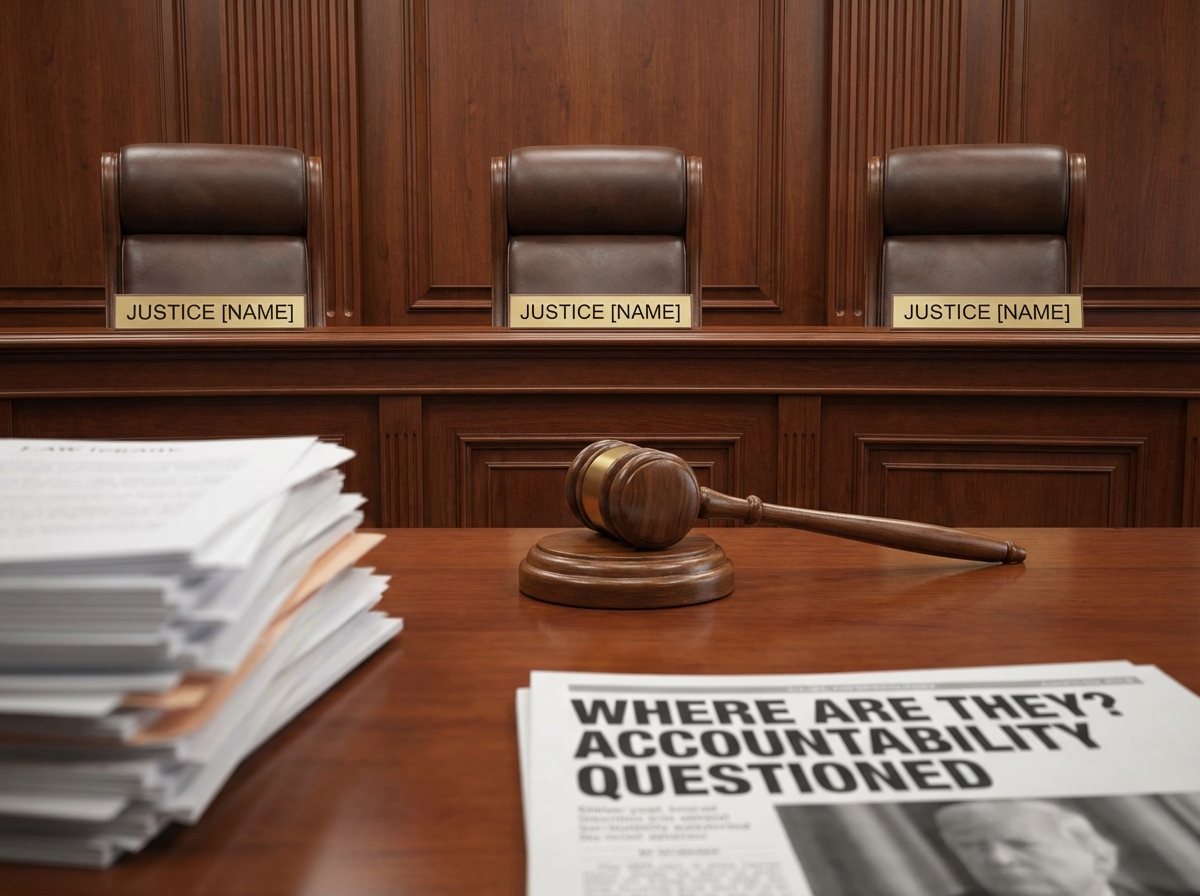
An unexpectedly empty photo accompanied the report’s release—a choice that many interpret as a symbol of the court’s current state of inaction. Legal observer Joyce Vance expressed her discontent, stating that the image “is a startling choice for a report about the judiciary.” Vance noted that the selection of an empty room was not merely an aesthetic decision but, arguably, a marker for what she sees as the court’s retreat from its public responsibilities during an era when every institution’s role is on edge.
In her critique, Vance painted a picture of an institution that is, according to her, too modest in its commentary on the pressing legal issues of our time. Instead of speaking plainly about the challenges confronting the judiciary and the political pressures it faces, the historic narrative seems to have fallen short of rallying the needed courage and clarity. Many felt that the court needed to take the wheel and speak out with plain, unambiguous truth.
Symbolism in Legal Communication
Symbols and imagery play a key role in shaping public perception. In legal and political discourse, the choice of how to represent an institution can have super important implications. Here are several points to consider regarding the use of symbolism in Chief Justice Roberts’ report:
- The Empty Room: Conveys a sense of absence and silence at a time when authoritative commentary is needed.
- Historical Frameworks: While using historical references can reassure some of the long-standing foundations of the judicial system, it might also be interpreted as a reluctance to engage with current, nerve-racking challenges.
- Implicit Messaging: Without clear dialogue about modern controversies, images and historical allusions serve as a double-edged sword, providing comfort for some but frustration for others expecting proactive leadership.
These subtle details—from the chosen photo to the historical anecdotes—embody a visual and thematic narrative about the court’s role. The messaging may feel safe but fails to address the immediate and intimidating complexities of today’s political landscape. Critics argue that choosing to focus on the past when modern tensions are high leaves a gap between public expectation and institutional response.
Political Pressures and the Judicial Function
The judiciary’s role in a democratic society is both central and subtly complicated. In recent years, the politicization of judicial decisions has led to a climate where judges are frequently put under a microscope, their decisions scrutinized not solely for their legal grounding but for their political implications. Such a climate makes it more challenging for the bench to remain above political fray without appearing disconnected from pressing realities.
Critics of recent developments claim that the court has, at times, been too silent amid politically charged controversies. This silence has, in some circles, been interpreted not as a respectful nod to the traditional separation of powers, but rather as a middle-of-the-road approach that leaves important issues unresolved. The debate continues as to whether the court’s reticence is a necessary part of judicial impartiality or an avoidance of confrontations that are super important in the moment.
Legal Precedents and Modern Challenges
Historically, measures to protect the independence of the judiciary were established with clear protective mechanisms, such as life tenure and salary guarantees. These measures were designed to insulate judges from the twisted parts of political pressure. However, the current era is rife with a different kind of pressure—one that comes not from structural vulnerabilities but from a broader societal climate that questions, and sometimes openly defies, traditional legal boundaries.
The court is now walking through a minefield where each decision is watched closely for political bias. The legacy of past trials, such as the impeachment process of Justice Samuel Chase, reminds us that using impeachment as a tool against judicial decisions is inappropriate, yet recent actions by political figures suggest that the judiciary is once again becoming embroiled in partisan disputes.
In this sensitive context, the court’s approach to uphold tradition while managing modern expectations is full of convoluted bits and nerve-racking misunderstandings. What should once have been a story about the history of judicial independence has transformed into a complex commentary on the state of American democracy.
Finding a Balance Between Tradition and Transparency
At the heart of the debate is a central question: How can the judiciary affirm its independence without coming off as detached from the palpable political tensions of our time? The answer, many argue, lies in a careful balancing act that pays homage to historical foundations while engaging directly with the messy, intimidating realities of today’s political environment.
On one hand, emphasizing the historical underpinnings of judicial independence—such as the protections enshrined in the Constitution—can provide a steady foundation. On the other, failing to address contemporary challenges directly may leave American citizens questioning whether the court remains capable of reviewing modern tensions robustly.
Key Strategies for a Transparent Judiciary
Below are several strategies that might help bridge the gap between historical reverence and contemporary accountability:
- Clear Communication: The judiciary should provide unambiguous explanations of its reasoning, especially in times when legal decisions are subject to intense political pressure.
- Engagement with Criticism: Instead of sidestepping contentious issues, the court could benefit from engaging with critical viewpoints in a manner that conveys both historical wisdom and modern awareness.
- Educational Outreach: Developing programs and publications that help the public dive into the fine points of judicial history and its relevance today would bridge understanding gaps.
- Contextual Analysis: Presenting legal decisions with context that acknowledges the present political climate, while remaining firmly rooted in constitutional principles, might help reassure a wary public.
Each of these strategies represents an effort to manage your way through the labyrinthine relationship between legal tradition and political modernity. They call on the judiciary not only to stand as a bulwark of constitutional protection but also as a transparent institution ready to address the overwhelming political pressures of our time.
The Critical Role of Judicial Courage
Many critics lament the perceived absence of forthright leadership from the court in critical moments. Former U.S. attorney Barbara McQuade, for instance, appreciated the historical insights provided by Chief Justice Roberts, particularly his reference to Samuel Chase. However, she expressed a desire for a bolder stance on judicial independence—a move that might have more clearly signaled the court’s commitment to standing firm when political pressures mount.
McQuade’s argument echoes a broader sentiment among legal observers: during a period marked by nerve-racking political strife and unpredictable provocations, judicial courage is not just desirable—it is essential. Even as the court steadfastly avoids overt political involvement, many believe that a little plain and unambiguous truth would resonate more deeply than an appeal solely to the heritage of the nation.
The Importance of Speaking Out
When faced with overwhelming political and public pressures, the judiciary can risk being perceived as weakly positioned, indirectly endorsing the status quo rather than challenging it. The following points illustrate why speaking out, even in a measured way, remains key for maintaining public trust:
- Reasserting Accountability: By clearly articulating its role, the court can affirm that it remains accountable to the principles of justice and fairness, irrespective of prevailing political winds.
- Deterring Political Overreach: A judicious and transparent communication strategy can serve as a warning against the misuse of impeachment threats as a reactionary political tool.
- Inspiring Confidence: Clear and forthright messages from the highest court help bolster public confidence in a system that is meant to serve as the guardian of constitutional rights.
Critically, such an approach does not require turning the judiciary into a partisan battleground but rather reaffirms its role as an institution grounded in principles that have guided America through many periods of crisis. This reassertion of judicial courage, as epitomized in historical episodes yet refined for modern challenges, might be what is most needed at this juncture.
Exploring the Impact of Political Criticism on the Supreme Court
It is important to acknowledge that criticism aimed at the Supreme Court does not occur in a vacuum. Public statements, political rhetoric, and media portrayals all contribute to a bustling atmosphere where the court’s authority is both contested and championed. The current political climate, in many respects, is full of problems that prevent clear communication between the judiciary and the public at large.
Critics argue that as the judicial branch faces off against an increasingly aggressive political establishment, its silence—interpreted by some as inaction—only exacerbates concerns about the erosion of judicial independence. In such an environment, every decision, every public statement, and every carefully chosen image is loaded with issues that extend well beyond simple legal theory.
The Role of Media Narratives in Shaping Perceptions
The media, playing a central role in framing legal discourse, has a responsibility to accurately represent the judicial approach amid political controversies. The tone and content of media narratives not only influence public sentiment but also contribute to the broader discussion on the role of the court in a democracy. Here are some key aspects of this dynamic:
| Aspect | Media Impact |
|---|---|
| Selection of Images | Can evoke feelings of abandonment or resilience depending on the context. |
| Choice of Historical References | Reinforces traditional values but may also appear as a deflection from current challenges. |
| Tone of Reporting | Neutral reporting might be misconstrued as passive, while assertive commentary can be polarizing. |
For the media, the challenge remains to balance factual reporting with a sensitivity to the nerve-wracking realities of today’s politically charged environment. Such a balance is necessary not only to inform the public accurately but also to ensure that a critical institution like the Supreme Court is portrayed with the nuance that its role demands.
Looking Forward: The Supreme Court’s 2026 Docket and Its Broader Implications
As the court prepares to consider consequential cases on presidential authority, immigration limits, and other critical issues intersecting law and politics, the stakes could not be higher. In the lead-up to the nation’s 250th anniversary in 2026, every decision that the Supreme Court makes is under intense scrutiny—not just from politicians, but from an engaged public that expects transparency, courage, and a steadfast commitment to constitutional values.
While Chief Justice Roberts’ report calls attention to the enduring strength found in America’s founding documents, it leaves many questions unanswered about how the court will tackle the overwhelming challenges of our time. The absence of a direct critique of recent political overreach has prompted calls from legal experts for a bolder stance—one that goes beyond cloaking judicial decisions in the mantle of historical precedent.
Implications for Future Jurisprudence
Looking ahead, there are several important considerations for the court as it addresses issues that are both super important and modern-day in scale:
- Presidential Authority: Any decision relating to the limits—or the expansion—of presidential power will have far-reaching consequences for the balance of power in the federal government.
- Immigration Policy: Cases on immigration are expected to test the bounds of constitutional interpretation, with the court under pressure to balance national security with individual rights.
- Political Accountability: With critics arguing that political actors are attempting to undermine the judiciary, future rulings may serve as a litmus test for whether the court can find your way through an increasingly tangled maze of partisanship.
Each of these areas is steeped in subtle details that require more than just a historical lens—they need a forward-looking approach that addresses modern challenges while safeguarding the judicial system from being overwhelmed by political interference.
Building Public Confidence Through Clear Institutional Actions
An underlying theme in the courtroom and in public dialogue is the need for the Supreme Court to be seen as a bulwark of fairness and constitutional stability. If the institution remains on edge—perceived as giving in implicitly to political pressures—its ability to command public trust may be seriously undermined.
To build and maintain public confidence, the judiciary must strike a careful balance between tradition and immediate relevance. Recognizing the overwhelming political criticism and the tension in current public discourse, the court needs to deploy strategies that demonstrate its commitment to justice, even as it steers through complicated legal and political terrains.
Initiatives to Foster Trust and Transparency
Here are several key initiatives that could help the Supreme Court maintain its impartiality while ensuring that its actions resonate positively with the public:
- Enhanced Public Engagement: The court should consider hosting public forums or releasing supplementary material that explains its decisions in everyday language, thereby making the fine points of its judgments accessible to ordinary citizens.
- Regular Updates on Strategic Priorities: Offering periodic insights into the challenges faced and the measures taken to address them could help demystify the judicial process at a time when many are left confused by political commentary.
- Collaboration with Legal Scholars: Working alongside academic and legal experts to articulate the reasoning behind key decisions could provide a clearer picture of the court’s stance in a tense political moment.
Each of these initiatives serves not only to clarify the court’s position but also reinforces the narrative that, even in challenging times, the judiciary remains firmly rooted in the principles that have guided American legal thought for centuries.
Concluding Thoughts: A Call for Clear, Courageous Leadership
The discourse surrounding Chief Justice Roberts’ report has shed light on a deeply rooted debate about the nature of judicial independence in the modern era. In trying to wake up a public steeped in confusion and overwhelming political rhetoric, the report evokes both comfort and critique—comfort in its reminder of beloved historical documents, and critique in its apparent omission of a robust response to today’s political turmoil.
Many legal experts, from seasoned prosecutors to respected former attorneys, argue that in these tense times, the Supreme Court must not shy away from addressing modern challenges in clear, plain terms. It is one thing to reference the storied past of judicial independence, but quite another to meet current critiques with the plain, unvarnished truth that inspires confidence and resilience.
In light of the evolving legal landscape, this call for judicial fortitude is more than a plea for action—it is a reminder that the health of American democracy itself may depend on the ability of its highest court to find a path forward amid the tricky parts and tangled issues of modern politics.
Looking Ahead: A Roadmap for the Future
As we inch closer to a momentous milestone in the nation’s history, the Supreme Court faces a future that is as challenging as it is consequential. Whether through decisive public statements, clarifying its strategic priorities, or embracing innovative outreach initiatives, the court’s leadership must come to the forefront.
The legal community can take heart from the fact that the principles of judicial independence are as deeply embedded as the very foundations of American governance. However, for these principles to remain relevant, they must be communicated in a manner that resonates with today’s citizens—those who are navigating not only the fine shades of legal argot but also the overt, intimidating political pressures of contemporary society.
Ultimately, the court’s ability to balance historical legacy with modern accountability will determine whether it can once again serve as a beacon of impartial justice. In a time when many feel that institutions are loaded with issues, it is essential for the judiciary to reaffirm its role, not by retreating into the past, but by engaging directly with the pressing realities of today.
Final Reflections
A deep dive into the heated debates triggered by Chief Justice Roberts’ report reveals an institution at a crossroads. On one hand, the court stands on a storied legacy that has weathered many a storm. On the other, it must confront a future where cutting through the twists and turns of political pressure requires more than tradition—it demands action, clarity, and yes, a little courage.
For the American public and the legal community alike, the call is clear: the judiciary must not only preserve its rich history but also communicate in ways that meet the pressing demands of modern governance. Whether it is through better public engagement, clear institutional messaging, or a newfound willingness to speak out when necessary, the time has come for a Supreme Court that is as formidable in its principles as it is effective in its public role.
This period of legal and political flux is a nerve-wracking reminder that democracy is a living system—one that evolves even as it clings to its foundational documents. As the nation moves forward, the judiciary’s actions will be closely watched. In these challenging times, the path ahead can only be successfully negotiated by embracing both the lessons of the past and the undeniable, pressing needs of the present.
In the final analysis, the debate surrounding the Supreme Court’s perceived silence is less about the absence of historical reverence and more about the critical need for direct, clear, and courageous leadership. It’s a reminder that while the fine points of legal tradition offer comfort, they must be combined with transparency and proactive engagement if the institution is to remain truly indispensable in today’s politically charged landscape.
Summary of Key Points
| Issue | Discussion Points |
|---|---|
| Historical Context | Highlights timeless principles but may overlook modern challenges. |
| Symbolic Messaging | Use of imagery such as the empty room underscores perceived inaction. |
| Political Pressures | Modern political rhetoric creates a nerve-wracking atmosphere demanding clear judicial responses. |
| Need for Transparent Communication | Initiatives for public engagement and clarifying key judicial decisions are critical. |
| Future Judicial Challenges | Upcoming cases on presidential authority and immigration will test the court’s ability to steer through complex issues. |
In reflecting on these issues, it becomes clear that the Supreme Court is faced with a multifaceted challenge: maintaining the charm of historical wisdom while boldly addressing the overwhelming and intimidating issues of today. The ongoing debate is a testament to the fact that clear, plain-language communication is not merely optional—it is a must-have strategy for preserving the integrity and functionality of our nation’s highest court.
Ultimately, a balance must be struck between honoring the legacy of judicial independence and adapting to the fine shades of our current political realities. As observers and citizens alike, we are left hoping that, in the years to come, the Supreme Court will find your way through these complicated pieces with the courage and clarity that history, and indeed the future of American democracy, demands.
Originally Post From https://www.newsweek.com/majority-of-supreme-court-justices-have-failed-to-show-up-legal-analyst-11300945
Read more about this topic at
Putting People Power into US Privacy Law
Carissa Véliz, Privacy Is Power: Why and How You Should …
